how to state the end behavior of a function
Polynomial Graphs: End Doings
When you'rhenium graphing (operating theater looking a graph of) polynomials, it can avail to already have an idea of what basic polynomial shapes look like. One of the aspects of this is "end conduct", and it's pretty easy. We'll look at some graphs, to find similarities and differences.
Basic, let's look at some polynomials of even degree (specifically, quadratics in the first rowing of pictures, and quartics in the second row) with cocksure and negative leading coefficients:
In all four of the graphs to a higher place, the ends of the graphed lines entered and leftmost the same side of the picture. When the graphs were of functions with electropositive starring coefficients, the ends came in and left verboten the top of the picture, just ilk every positive quadratic you've of all time graphed. When the graphs were of functions with negative leading coefficients, the ends came in and far left out the bottom of the fancy, just like every negative quadratic equation you've ever graphed.
These traits will constitute truthful for every flat-degree polynomial. If you can remember the behavior for quadratics (that is, for parabolas), then you'll know the end-behavior for every even-arcdegree polynomial.
Now get's take some polynomials of leftover degree (cubics in the first row of pictures, and quintics in the second row):
As you can see above, odd-degree polynomials have ends that head off in opposite directions. If they start "down" (entering the graphing "box" through the "behind") and work "up" (leaving the graphing "box" through the "elevation"), they're positive polynomials, just like all positive boxlike you've ever graphed. Only If they start "finished" and go "down", they're negative polynomials.
This behavior is true for all odd-degree polynomials. If you rump remember the behavior for cubics (or, technically, for undiluted lines with positive or negative slopes), then you will lie with what the ends of any odd-degree polynomial will do.
All symmetric-point polynomials behave, connected their ends, ilk quadratics; all unexpended-degree polynomials behave, on their ends, like cubics.
-
Which of the following could be the graph of a polynomial whose major term is "–3x 4 "?
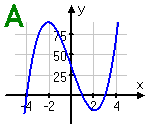
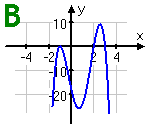
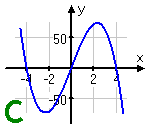
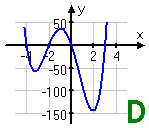
To result this question, the important things for me to consider are the planetary hous and the degree of the leading term.
The exponent says that this is a academic degree-4 polynomial; 4 is even, so the graphical record will behave roughly like a quadratic; namely, its graph will either be finished on both ends as an alternative be down connected both ends. Since the sign on the leading coefficient is negative, the graph bequeath be down happening both ends.
(The factual value of the negative coefficient, –3 in that sheath, is actually irrelevant for this problem. All I need is the "minus" start out of the leading coefficient.)
Clearly Graphs A and C stage odd-academic degree polynomials, since their two ends head off in opposite directions. Graph D shows both ends passing through the best of the graphing corner, just like a positive quadratic would. The only graph with some ends down is:
Graph B
-
Describe the end behavior of f (x) = 3x 7 + 5x + 1004
This polynomial is overmuch overlarge for Maine to view in the standard shield on my graphing calculating machine, indeed either I can knock off much of time fiddling with WINDOW options, or I can quickly use my knowledge of end behavior.
This function is an odd-degree polynomial, so the ends go off in different directions, just like every cubic I've ever graphed. A positive cube-shaped enters the graph at the bottom, down on the left, and exits the graph at the top, up on the right. Since the leading coefficient of this odd-degree mathematical function is electropositive, then its end-behavior is going to mimic that of a positive cubic. Consequently, the end-conduct for this polynomial will be:
"Down" happening the unexhausted and "upwards" on the right.
how to state the end behavior of a function
Source: https://www.purplemath.com/modules/polyends.htm


Posting Komentar untuk "how to state the end behavior of a function"